insights

IC3 Dialogues

Play icon

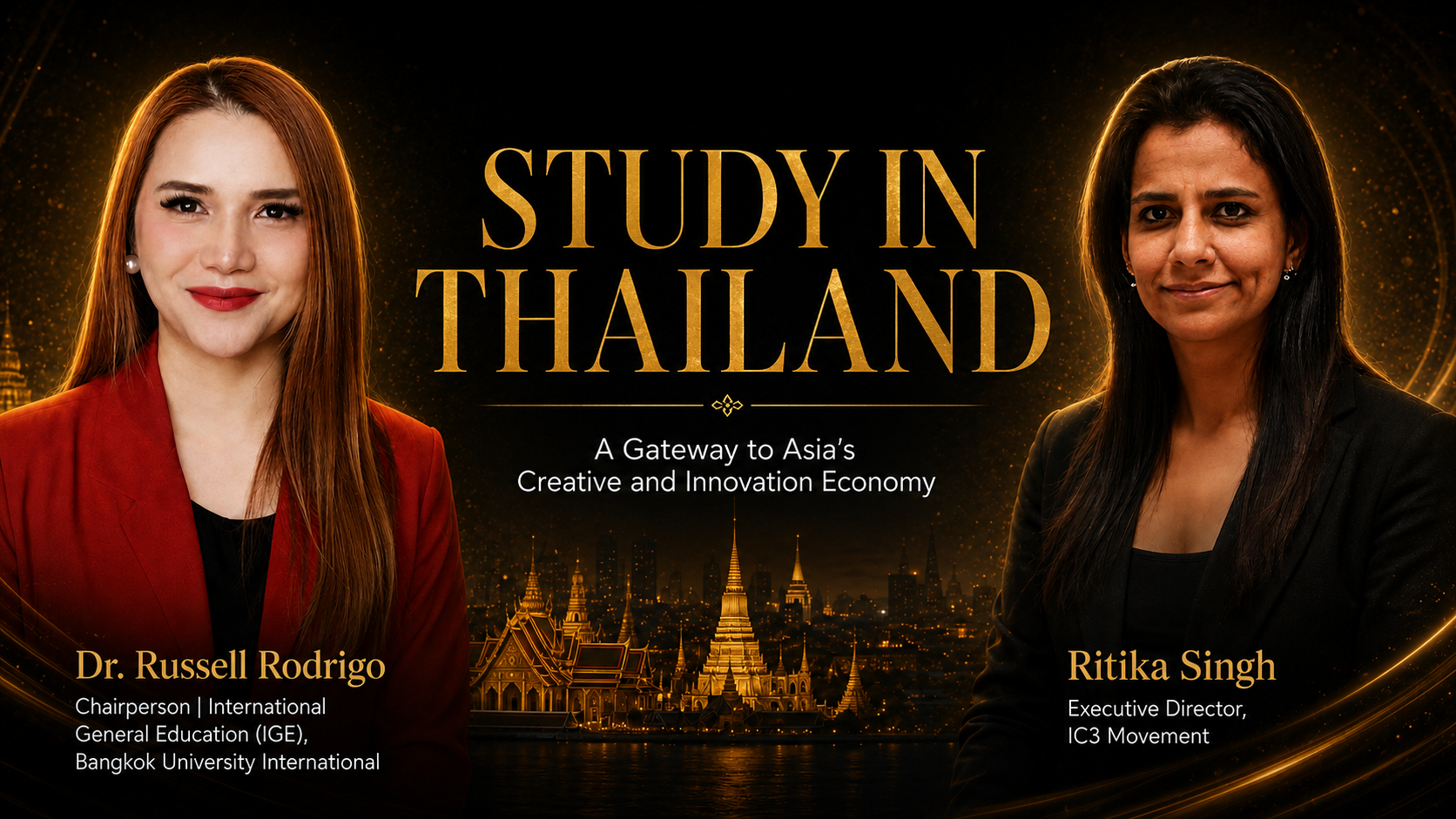
Why Southeast Asia is the New Hub for Creative Innovation & Education

Dr. Rodrigo, Chairperson of the International General Education Program at Bangkok University, and Ritika Singh, Executive Director - The IC3 Movement, discuss Thailand's emergence as an affordable and diverse hub for global higher education. Their conversation explores Bangkok University's commitment to experiential learning, entrepreneurial mindsets, and building the critical skills needed for an AI-driven world. Ultimately, the discussion highlights how studying in this dynamic environment can transform students into independent, globally-ready professionals.
Play icon

Unlearning Education: How to Stay Relevant in a Rapidly Changing World

In this candid conversation, Ronnie Screwvala, Chairperson & Co-Founder - upGrad, joins Ganesh Kohli, Founder of the IC3 Movement, to share his unique journey of resilience across diverse fields. He challenges conventional thinking in academia, emphasizing the need for educators to reinvent their approach, embrace vulnerability, and foster open-minded conversations. By redefining success away from short-term grades and shifting the focus to how students evolve over the next decade, the discussion highlights the ultimate importance of long-term life and career readiness. It serves as a compelling call to action for educators to move from clinical instruction to a dynamic framework centered on genuine connection and action-oriented learning.
Play icon

Skill Set vs. Industry: How to Choose Your Creative Path

Are you trying to "manicure" the perfect career path for yourself or your child? In this insightful conversation with Ganesh Kohli, Founder of IC3 Movement, Chaitanya Chinchlikar, Vice President, CTO & Emerging Media Head - Whistling Woods International, explains why curiosity - not just courage - is the ultimate driver of success in the modern world. Together, they discuss the transformation of creative education, the importance of curiosity in career development, and how institutions can stay relevant in a rapidly changing world. Explore the intersection of business, craft, and technology as they deconstruct the silos traditionally found in school education. Learn how institutions can stay relevant by "coming back from the future" to prepare students for careers that don't even exist yet.
Play icon

Are Degrees Enough Anymore? Preparing Students for the Jobs of Tomorrow

Education is evolving faster than ever. For generations, students followed a familiar path: choose a stream, earn a degree, and build a career. Today, that formula is being rewritten. Careers are becoming more dynamic, interdisciplinary, and skills-driven, requiring students to adapt, experiment, and continuously learn. In this episode of the IC3 Conversations, Ganesh Kohli, Founder - IC3 Movement, is joined by Dr. Indu Shahani, Founding President and Chancellor of ATLAS SkillTech University, to explore what education must look like in a world where careers are no longer linear and the most exciting opportunities often exist at the intersection of multiple disciplines.

Blogs

Why cross-border collaboration is essential for student success

• June 26, 2026
In an increasingly interconnected world, cross-border collaboration in education is no longer optional; it is a necessity for student success. This blog highlights how schools, universities, counselors, and industry leaders must partner together to prepare students for a globalized workforce. By breaking down national boundaries, educational institutions can provide comprehensive guidance, expand access to international opportunities (both physical and virtual), and expose learners to diverse perspectives. Ultimately, these global partnerships equip students with critical skills like cultural awareness, empathy, and adaptability, fostering an inclusive global education community dedicated to helping every learner thrive.

The essence of change: Redefining the value of a modern degree

• June 18, 2026
While today’s students have endless access to university rankings and salary data, this information overload doesn't always lead to better higher education choices. Driven by discussions at the IC3 conference in Mumbai, this blog explores the critical shift from surface-level data collection to deep insights regarding student employability. The blog highlights that true ROI in education goes beyond a graduate’s first job title. Instead, long-term career progression relies on building transferable human skills—like adaptability, resilience, and AI proficiency - to thrive in a shifting global workforce. Using the University of Southampton’s approach as a model, the piece outlines how embedding industry exposure into the academic experience, fostering global networking, and empowering the evolving role of school counselors are vital to preparing students for lifelong career success.

Navigating identity in the working world: Helping students build authentic and future-ready career pathways

• June 05, 2026
In today’s rapidly evolving job market, technical skills and a flawless transcript are no longer enough. To truly thrive, students need a profound understanding of who they are. This blog explores the critical intersection of personal identity and career development, highlighting why educators, counselors, and university leaders must prioritize self-awareness to prepare students for the modern workforce.

In an AI-Powered world, teachers matter more than ever

• May 29, 2026
While AI is successfully automating administrative tasks and reducing teacher burnout, it poses a hidden risk: reducing the deeply human art of teaching into procedural data management. To remain transformative, education must balance technological efficiency with irreplaceable human empathy.

News & Updates

Wellbeing
4
 mins
September 30, 2024

Student suicides rising in India: The stigma and the silence

Recent incidents of student suicides in India highlight the growing mental health crisis among the youth. Despite efforts to address the issue, factors like academic pressure, lack of support, and stigma around mental health continue to contribute to this alarming trend.